The first hint that something was off didn't come from a dashboard I was staring at.
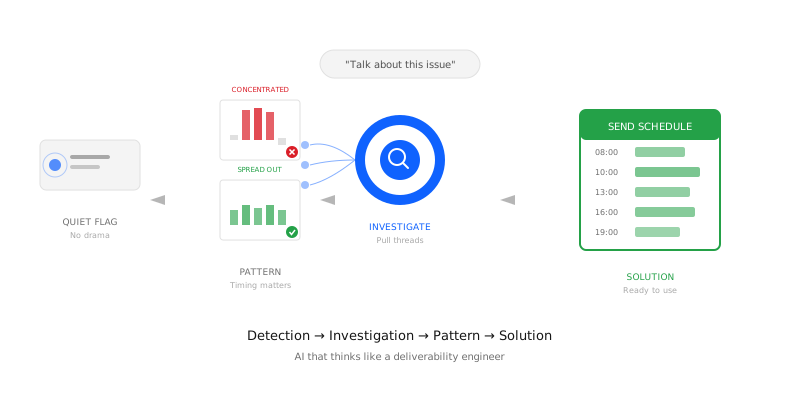
It came from the system quietly flagging an issue on its own.
No panic, no "everything is on fire" messaging — just a restrained observation: one sending stream was seeing a sustained level of deferrals at a major mailbox provider. Not blocks, not failures. Delays.
The kind of thing a human might scroll past on a busy day and think, I'll look at that later.
This time, the AI didn't.
The autonomous agent had already done the boring part: checked volume thresholds, persistence, blast radius, and whether this was a one-day blip or something reproducible. It decided it was real enough to surface, but not severe enough to shout about.
So it flagged it. Calmly.
That alone was interesting.
Phase one: detection without drama
At this stage, the "issue" was deliberately modest in scope.
Same mailbox provider. Same sending identity. Same days of the week. Same hours of the day.
Deferrals were elevated, but nothing was failing permanently. Everything eventually delivered. Engagement looked healthy. Complaints were nonexistent. Bounce rates were clean.
In other words, it didn't look like reputation damage, content filtering, or list rot — the usual villains.
Which is precisely why this kind of problem tends to linger. There's no obvious lever to pull, no smoking gun metric screaming for attention.
The autonomous agent stopped there. Its job wasn't to speculate, only to say: this pattern exists, it's material, and it's persistent.
So we clicked the button.
"Talk about this issue"
That's where things got fun.
The "Talk about this issue" action doesn't just restate the alert. It drops you into the AI Studio with full context: the flagged issue, the surrounding metrics, and permission to ask follow-up questions against the actual data.
The first prompt was intentionally vague: Help me understand what's really going on here.
Instead of jumping straight to conclusions, the AI did something subtle but important. It checked whether this was already known, whether similar issues had been logged before, and whether there was any obvious overlap.
Then it started pulling threads.
It compared identities. It looked at deferral categories. It mapped volume by day. Then by hour.
And slowly, a shape emerged.
Phase two: the pattern you don't see at first glance
The breakthrough wasn't about how much mail was being sent.
It was about when.
On days where volume was spread out, deferrals were minimal. On days where the same volume was concentrated into narrow windows, deferrals spiked — sharply, predictably, and always in the same hours.
Nothing else changed.
Not the content. Not the audience. Not the sender. Not the mailbox provider.
Just timing.
At this point, the AI stopped talking about "issues" and started talking about behavior. It wasn't accusing the sender of doing anything wrong. It was describing how the receiving system was responding to velocity.
Which is a very different framing.
This wasn't punishment. It was feedback.
Same volume, spread across the day? Fine. Same volume, stacked into peaks? Throttle.
No sinister algorithm. No hidden blacklist. Just math — quiet, statistical, deeply unemotional math.
Phase three: realizing what isn't the problem
Here's where the conversation could have gone off the rails, and often does with traditional analysis.
Maybe the content feels too promotional, the list isn't quite as clean as we think, or perhaps the domain reputation hasn't fully settled yet. All reasonable thoughts — and all wrong in this case.
Because the AI could check.
Engagement was strong, and not inflated by bot opens or proxy noise. These were human opens. Complaints were zero. Hard bounces were well within tolerance. In fact, some parallel streams with more volume were cruising through just fine.
That contrast mattered.
It ruled out quality problems and pointed squarely at operational ones. Specifically: sending velocity during warm-up, combined with sharp hourly concentration.
At this point, the issue wasn't just understood. It was contained.
But the conversation didn't stop there.
"Do you want me to design a fix?"
That was the unexpected turn.
Instead of ending with recommendations like "monitor closely" or "consider adjusting send times", the AI asked whether it should actually propose a send-time optimization model.
Not a generic one. A concrete, hour-by-hour schedule, taking into account time zones, mailbox provider behavior, warm-up constraints, and observed deferral thresholds.
We said yes.
Phase four: from diagnosis to design
What came next wasn't an alert, or even an explanation. It was a plan.
The AI mapped recipient geography against local time, translated that into the sender's operational timezone, and overlaid known engagement windows. Then it pressure-tested those windows against known rate-limit behavior.
The result wasn't dramatic. It was practical.
Instead of two heavy send peaks, volume was redistributed into calmer waves. Instead of hammering the same hours every day, traffic was smoothed. Nothing new was invented; existing volume was simply allowed to breathe.
Crucially, this wasn't guesswork. Every recommendation was tied back to observed data from earlier phases of the investigation.
The system didn't just say what to do. It could explain why this would work, and what metrics would confirm success within 24, 48, and 7 days.
That's the point where this stopped being "an AI finding an issue" and started being "an AI thinking like an experienced deliverability engineer."
What stuck with me
The most interesting part of all this wasn't that AI detected a problem, or even that it solved one.
It was the way the process unfolded.
First, a system noticed something quietly and responsibly. Then, a human asked it to explain itself. Then, together, they explored, ruled things out, tested assumptions, and refined the model until the answer wasn't just correct, but usable.
No drama. No panic. No rewriting content that didn't need rewriting.
Just a conversation with the data that got progressively sharper.
This is what "AI in deliverability" actually looks like when it works. Not a replacement for human judgment, but a system that can watch continuously, reason patiently, and keep digging long after a human would've been pulled into their next meeting.
Sometimes the most valuable thing it gives you isn't the alert.
It's the confidence to say: nothing is broken — we just need to send a little differently.
And sometimes, it even hands you the schedule.