It's 3:17 AM. Somewhere in your infrastructure, a monitoring system fires off an alert: "Gmail bounce rate exceeded 2.5% threshold."
The alert is technically correct. The bounce rate is 2.7%. What the alert doesn't mention: it's isolated to a single re-engagement campaign targeting dormant subscribers—people who haven't opened in 18 months. Of course they're bouncing. That's the whole point of the campaign.
Your on-call engineer wakes up, checks the dashboard, mutters something unrepeatable, and goes back to sleep.
Meanwhile, the actual problem—a DKIM key rotation that didn't propagate correctly to your promotional sending domain—has been silently tanking inbox placement for six hours. By morning, 340,000 emails will have landed in spam. You'll discover this around 11 AM, when someone finally asks why the click-through rate on the Tuesday newsletter looks "weird."
I've seen this exact scenario play out at least a dozen times in 27 years of deliverability consulting. Different companies, different ESPs, different root causes. Same pattern: the alert system crying wolf at 3 AM, while the real wolves walk right through the front door.
The Uncomfortable Truth About Your Monitoring
Every email platform sells you on visibility. Dashboards. Charts. Thresholds. Real-time alerts.
Here's what they don't tell you: most email monitoring is actually historical logging with a fancy UI.
A threshold alert doesn't tell you something is wrong. It tells you something was wrong, probably hours ago, and here's a number that proves it. What it doesn't tell you is why, or whether you should actually care, or what to do about it.
The setup seems reasonable:
- Bounce rate crosses 2%? Alert.
- Complaint rate exceeds 0.1%? Alert.
- Open rate drops 15%? Alert.
The reality is chaos:
When something genuinely goes wrong—say, a shared IP gets blocklisted—you don't get one alert. You get forty-seven. Bounce alerts. Complaint alerts. Engagement alerts. Latency alerts. All symptoms of the same root cause, each one demanding individual acknowledgment, each one cluttering the channel until your team learns to ignore them.
That's the real danger. Alert fatigue isn't a bug. It's an inevitability.
I worked with a financial services client last year who had 2,400 unread alerts in their monitoring queue. When I asked how they managed incident response, the team lead laughed and said, "We wait until someone complains."
They weren't negligent. They were rational. When 95% of your alerts are noise, treating alerts as signal is a losing strategy.
The Problem Nobody Wants to Admit
Here's something I've learned after nearly three decades in email: dashboards are where good intentions go to die.
Everyone builds them. Nobody checks them.
I don't mean nobody ever checks them. I mean nobody checks them proactively, consistently, at the frequency required to catch problems early. Dashboards get checked after incidents, during post-mortems, when a client asks a question. They're forensic tools, not preventive ones.
Why? Because dashboards assume humans have unlimited attention and unlimited time. In reality:
Your deliverability engineer is also handling ESP migrations, authentication updates, compliance reviews, and that one sales guy who keeps asking why his personal emails land in spam. The dashboard is item seventeen on a twelve-item to-do list.
Even when someone does check, pattern recognition across multiple dimensions is cognitively brutal. Noticing that German mobile users on iOS 17+ receiving promotional emails from ESP #2 on Tuesdays are underperforming requires holding six variables in your head simultaneously. Human brains aren't built for that.
So the dashboard sits there, holding the answer to questions nobody has time to ask.
What "Investigation" Actually Looks Like
Let me tell you about a Tuesday morning.
A client's Gmail engagement dropped 23% overnight. The alert fired at 9:04 AM. Here's what happened next:
Total time to resolution: 6 hours. Root cause identification: 4+ hours of human investigation. Revenue impact: Estimated €47,000 in lost conversions over six days.
The frustrating part? The data to diagnose this existed from minute one. The correlation between the DKIM change and the engagement drop was sitting right there in the logs. But a human had to notice it, hypothesize about it, validate it, and confirm it.
That's not monitoring. That's archaeology.
How Autonomous Investigation Changes Everything
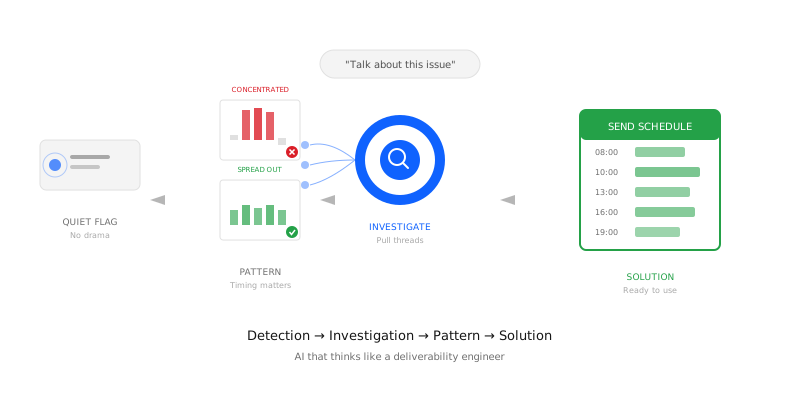
When we built Engagor, we had a choice. We could build another dashboard—better charts, more data sources, prettier UI. Or we could build something that investigates for humans.
We chose the second path. Here's what that actually means:
Severity: High | Affected: ~340,000 emails over 6 days
Promotional emails from [domain] are failing DKIM alignment since the selector rotation on [date]. The new DKIM key was not propagated to the promotional sending subdomain.
Recommendation: Verify DKIM DNS records for [subdomain] and ensure the new selector is published.
Total time to resolution: 45 minutes after team arrives. Root cause identification: Automatic. Human investigation time: Zero.
The difference isn't just speed. It's cognitive load. The team didn't spend four hours playing detective. They reviewed a completed analysis, validated it made sense, and fixed the problem.
What Changes When Investigation Is Autonomous
Alert fatigue disappears. Not because you get fewer notifications, but because each one is pre-investigated, contextualized, and actionable. You stop ignoring alerts because they stop being noise.
Dashboards become optional. You don't need to proactively monitor them—the AI does that. Dashboards become exploration tools for when you want to dig deeper, not a daily obligation you feel guilty about skipping.
24/7 coverage becomes real. Not "we have alerts that fire overnight." Real coverage—issues investigated and diagnosed regardless of timezone, weekend, or holiday.
Post-mortems get boring. When every insight includes root cause analysis, incident retrospectives become fifteen-minute reviews instead of two-hour archaeological digs.
Email operations has worked the same way for twenty years. It's breaking down now because the complexity has outpaced human capacity.
The question isn't whether autonomous investigation makes sense. It's whether you'll adopt it before or after your next preventable incident.
Engagor's AI investigates your email ecosystem 24/7, surfacing insights with root cause and recommendations—so your team can act instead of investigate.