"Why don't you just consolidate to one ESP?"
I've heard this question approximately ten thousand times over the past two decades. Usually from someone selling an ESP. Sometimes from well-meaning consultants. Occasionally from executives who see the line items and wonder why they're paying four different vendors.
The question assumes that multi-ESP environments are a problem to be solved—a symptom of poor planning or organizational dysfunction. Consolidate the stack, consolidate the costs, consolidate the complexity. Simple.
It's also terrible advice for most enterprises. Here's why.
How Companies Actually End Up With Multiple ESPs
Nobody sets out to run five ESPs. It just... happens.
Acquisitions. You acquire a company that runs on Mailgun. Your team uses SendGrid. Now you have both, with different lists, different templates, different integrations. Migrating would take eighteen months and nobody's sure it's worth the disruption.
Use case specialization. Your marketing team picked Braze for lifecycle automation. Your product team chose SendGrid for transactional. Your customer success team implemented Mailchimp for their specific workflow. Each choice made sense in isolation.
Regional requirements. EU data residency rules mean you need a platform with guaranteed European processing. Your APAC team needs local sending infrastructure for latency reasons. Your US team has been on SparkPost since 2016 and it works fine.
Vendor lock-in escape routes. After that time your ESP had a major outage during Black Friday, leadership mandated backup infrastructure. Now you actively maintain two platforms.
Politics. The CMO's team wants platform A. The CTO's team wants platform B. The compromise is both.
I've worked with enterprises running seven different ESPs—not because they're incompetent, but because they're large, complex organizations where decisions get made independently and history accumulates.
Why "Just Consolidate" Usually Fails
Let me tell you about a client who tried the consolidation path.
In 2022, they decided to migrate everything to a single ESP. They had four platforms at the time. The project was estimated at nine months.
Three years later, they still have three platforms.
The marketing migration went fine—six months of work, new templates, new automations, training, done. But the transactional emails were integrated with seventeen different backend systems. Migrating them required code changes in each system, QA cycles, deployment windows, rollback procedures.
The first three systems took eight months.
After that, the appetite for migration vanished. "Good enough" became the goal. Now they have one ESP for marketing and two for transactional, and nobody's talking about consolidation anymore.
This pattern is incredibly common. Migration projects start with momentum and end with exhaustion. The long tail of integrations kills the dream.
The Hidden Costs Nobody Calculates
The real argument for accepting multi-ESP reality isn't "migration is hard." It's that the costs of fragmentation are usually hidden while the costs of migration are visible.
When you run multiple ESPs, you're paying for:
Duplicate reporting work. Every platform has its own dashboard. Someone has to log into each one, export data, normalize it, compile reports. I've met analysts who spend 40% of their time just gathering data from different platforms.
Inconsistent metrics. As I wrote about in another post, each ESP defines metrics differently. "Delivered" means different things. Bounce classifications vary. Comparing performance across platforms requires normalization that often doesn't happen.
Blind spots. That sending domain you set up in ESP #3 for a campaign two years ago? Is anyone monitoring it? When was its DKIM last rotated? What's its current reputation? In fragmented environments, these questions often go unanswered.
Delayed incident response. When something goes wrong, which platform is affected? Is it ESP #2, or is the problem upstream? In multi-ESP environments, root cause analysis takes longer because the data is scattered.
Inability to see cross-channel patterns. A subscriber who ignores your marketing emails might respond to your transactional receipts. But if those live in different platforms, you can't see the full picture. Your engagement data is incomplete.
These costs are real. But they're diffuse—spread across people's time, missed insights, delayed responses. Nobody writes a check for "confused reporting." So the costs stay hidden while the migration project gets all the budget scrutiny.
The Single Pane That Actually Works
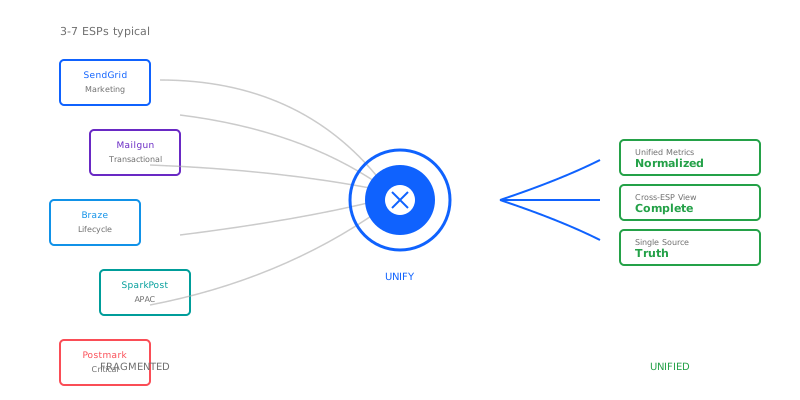
Here's the insight that led to Engagor: you don't need a single ESP. You need a single view.
Consolidating sending infrastructure is expensive, risky, and sometimes impossible. But consolidating analytics is straightforward.
Connect every ESP to a unified platform. Normalize the data as it arrives. Present it through a single interface that doesn't care whether the email went through SendGrid or Mailgun or PowerMTA.
Now your analyst logs in once. Your metrics are consistent. Your blind spots have light. Your incident response starts from unified data.
The sending stays distributed—because distributed often makes sense. The intelligence becomes unified—because fragmented intelligence never makes sense.
When to Actually Consolidate
I'm not saying consolidation is always wrong. Sometimes it's the right call:
When you're paying for ghost platforms. If you're maintaining an ESP that sends 1% of your volume because someone forgot to migrate the last integration, just migrate it.
When you have genuine feature gaps. If you need capabilities that only exist in platform B, and platform A can be fully replaced, do it.
When contracts align. If ESP #2's contract is expiring and migration wouldn't require major engineering work, consider it.
When the fragmentation is recent. Migrating after six months is much easier than migrating after six years.
But if you've got four platforms that each serve real purposes, you're spending millions to migrate, and you'll probably still have three platforms when it's done—maybe accept the reality and invest in unified analytics instead.
What Multi-ESP Success Looks Like
I work with clients who run sophisticated multi-ESP operations. Here's what the good ones have in common:
Clear purpose for each platform. Not "we ended up here" but "Platform A handles transactional because of latency. Platform B handles marketing because of automation features. Platform C handles the APAC region because of data residency."
Unified identity management. Every sending domain, every IP, every authentication record tracked in one place regardless of which ESP uses it.
Consistent monitoring. The same metrics, the same alerting, the same investigation tools across all platforms. No dashboard-hopping.
Cross-platform visibility. Ability to see a subscriber's complete engagement history across all ESPs. Ability to trace a deliverability issue regardless of where it originated.
Single source of truth. When leadership asks "how is email performing," there's one answer—not four different answers from four different dashboards.
This isn't theoretical. This is what Engagor does. We built it because I spent decades watching smart people waste time normalizing data between platforms instead of actually improving their email programs.
Engagor connects to 70+ ESPs and MTAs, normalizing every event into a unified analytics layer. Because your email intelligence shouldn't depend on your sending infrastructure.