In early 2023, I had a conversation that changed how I thought about email technology.
A client called me on a Sunday afternoon—never a good sign. Their Gmail engagement had dropped 40% over the weekend. They'd already spent six hours investigating: checking authentication records, reviewing recent campaigns, scanning blacklists. Nothing obvious.
By the time they called me, they were panicking.
I asked a single question: "What changed on Friday?"
Silence. Then: "We pushed a new template. But it's just visual changes. Same content, same links."
"Did you change the preheader text?"
More silence. Then the realization. They'd accidentally set the preheader to a test string: "Lorem ipsum dolor sit amet." Gmail's spam filters saw Latin gibberish and adjusted accordingly.
The investigation that took them six hours took me thirty seconds—because I've seen that pattern before. I knew which question to ask.
That's when I started thinking: what if AI could ask the same questions I would?
The Dashboard Paradox
I've spent 27 years watching people build email dashboards. Better dashboards. More dashboards. Dashboards with more charts, more filters, more real-time updates.
And I've spent 27 years watching those dashboards fail.
Not fail technically—they work fine. Fail operationally. People don't look at them. Or they look but don't see. Or they see but don't investigate. Or they investigate but too late.
The problem with dashboards is philosophical: they assume humans have infinite attention and infinite time. Build a beautiful visualization, and surely someone will notice when something goes wrong.
But attention is finite. Email operations teams juggle migrations, authentication updates, campaign reviews, stakeholder requests. The dashboard is one of forty tabs, checked when convenient, glanced at between meetings.
By the time someone notices the anomaly, the damage is done.
What Consultants Actually Do
When companies hire me for deliverability consulting, they think they're paying for knowledge. They're not. Knowledge is in documentation, blog posts, conference talks. Anyone can learn what DKIM is.
What they're actually paying for is investigative capacity.
When I look at an email program, I'm not just observing data. I'm forming hypotheses, testing them against patterns I've seen before, asking follow-up questions based on what I find. It's an active, directed inquiry.
"Engagement is down" is a starting point, not an answer. A consultant asks:
- Down for everyone or specific segments?
- Down across all ISPs or just Gmail?
- Down for recent sends or retrospectively across history?
- Did anything change recently—templates, lists, authentication, ESP?
- How does this compare to the same period last month/quarter/year?
Each answer narrows the possibility space. Each follow-up question is informed by the previous answer. Within minutes, you've gone from "something is wrong" to "here's what's wrong and here's what to do about it."
That's investigation. That's what dashboards don't do.
The Agentic Approach
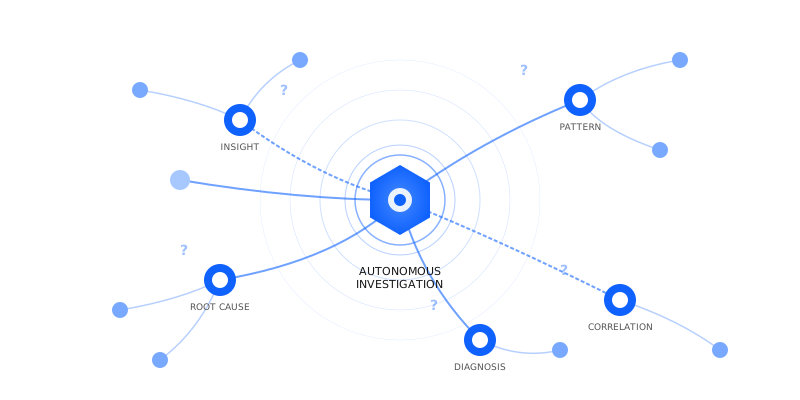
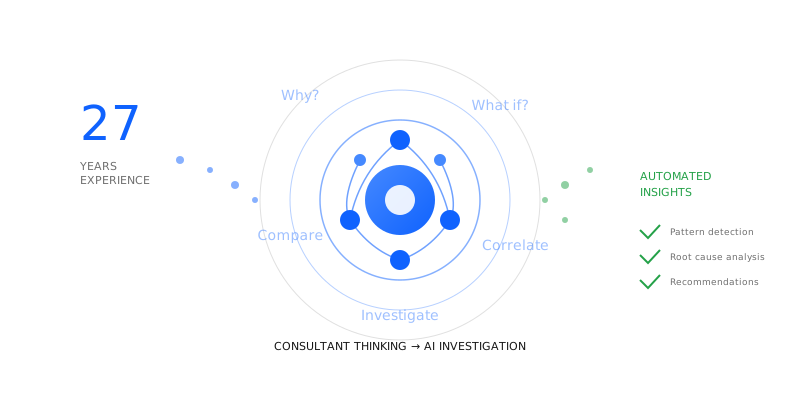
When we designed Engagor's AI, we didn't start with technology. We started with process: what does a good investigation look like?
Step 1: Continuous Observation
A consultant isn't checking dashboards once a day. They develop an intuition for normal, which lets them notice abnormal. The AI does the same thing, but with perfect memory and infinite attention. Every signal, every segment, every hour—compared against dynamic baselines that account for seasonality, day-of-week patterns, and historical context.
Step 2: Hypothesis Formation
When something deviates from expected, a consultant doesn't just flag it. They form theories. "This looks like a reputation issue." "This might be an authentication failure." "This pattern suggests list quality problems."
The AI does the same thing—not randomly, but based on patterns we've encoded from decades of consulting experience. Certain combinations of signals suggest certain root causes. The AI knows which hypotheses to test first.
Step 3: Autonomous Investigation
Here's where most "AI" tools stop. They flag anomalies. They might even categorize them. Then they wait for a human to investigate.
Our AI doesn't wait.
When it forms a hypothesis, it tests it. If the theory is "authentication failure on subdomain X," the AI checks authentication records for that subdomain. If the theory is "engagement drop isolated to ESP Y," the AI queries segment-level data to confirm or refute.
This happens in seconds. Without human input. At 3 AM on Christmas Day.
Step 4: Insight Delivery
The output isn't an alert. It's a completed investigation: what happened, why it matters, the most likely cause, supporting evidence, recommended action.
A human reviewing the insight isn't starting an investigation. They're reviewing one that's already finished.
A Real Example: The Sunday Extrapolation
I want to share a specific example that convinced me we were on the right track.
A client's AI insight flagged unusual engagement patterns for Sunday sends. Not bad engagement—unusual. The AI noticed that Sunday engagement at 2 PM was 15% higher than predicted, while Sunday engagement at 6 PM was 12% lower than predicted.
Normal monitoring wouldn't catch this. Overall Sunday engagement was fine—slightly above average. Nothing to alert on.
But the AI noticed the pattern was different from other days. On weekdays, 2 PM and 6 PM showed consistent relative performance. On Sundays, something shifted.
Here's what the AI did next—and this is the part that amazed me:
- It hypothesized that Sunday audience behavior might differ from weekday behavior
- It pulled hourly engagement data for weekends specifically
- It compared Sunday patterns to Saturday patterns
- It found that Saturday showed the same shift—lower afternoon, higher morning
- It concluded: weekend audiences engage earlier in the day than weekday audiences
The AI then recommended: "Consider shifting Sunday campaign deployment 2-3 hours earlier to align with observed engagement windows."
This wasn't a pre-programmed rule. The AI figured out it needed to compare Saturday and Sunday patterns, pulled the data, did the analysis, and formed a conclusion.
That's what I mean by "thinks like a consultant."
What "Agentic" Actually Means
The word "agentic" gets thrown around a lot in AI marketing. Most of the time, it means "chatbot that can call APIs."
That's not what we mean.
An agentic system doesn't just respond to queries. It observes, hypothesizes, investigates, and concludes—autonomously. It has goals (understand email health, surface problems early, provide actionable insights) and pursues them without being asked.
The distinction matters because it changes the human's role.
With a dashboard, humans do the work: monitoring, investigating, diagnosing. The technology just visualizes.
With a chatbot, humans direct the work: asking questions, requesting analyses. The technology just executes.
With an agentic system, humans review the work: evaluating insights, deciding on actions. The technology does the investigation.
That's a fundamental shift in how email operations can function.
Why This Matters
I've been consulting on email deliverability since 1998. I've written thousands of incident reports. The vast majority conclude with some variation of "this should have been caught earlier."
Earlier detection isn't a technology problem. The data exists. Earlier detection is an attention problem. Nobody was looking.
You can't hire enough analysts to monitor every signal across every segment every hour of every day. You can't expect humans to maintain that vigilance indefinitely. They'll get tired, distracted, promoted, or quit.
But AI doesn't get tired. It doesn't get distracted. It watches with perfect attention, forever.
The question isn't whether AI will transform email operations. It's whether you'll adopt it before or after your next preventable incident.
Engagor brings 27 years of deliverability expertise to every investigation, running 24/7, surfacing insights before problems become crises.