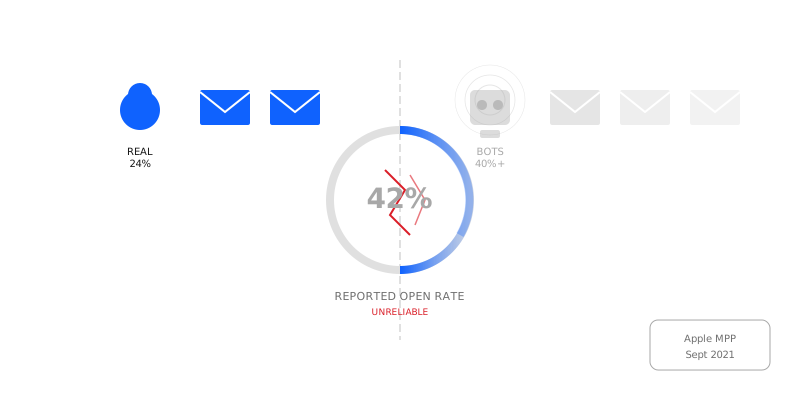
Last month, a client asked me to review their email program. "Our open rates are incredible," the marketing director said. "42% average. Best we've ever had."
I pulled up their segment breakdown. Apple Mail users: 67% open rate. Gmail users: 23%. Outlook users: 19%.
"Those Apple numbers are fake," I told her. "About 40% of your 'opens' are machines pretending to be humans."
She didn't believe me at first. Why would she? Her ESP dashboard showed a clear upward trend, beautiful charts, green checkmarks everywhere. The data looked real because it was presented like real data.
But it wasn't. And she'd been making business decisions based on fiction for two years.
The Day Open Rates Died
September 20, 2021. Apple released iOS 15 with a feature called Mail Privacy Protection. The marketing copy was friendly: "Mail Privacy Protection stops senders from using invisible pixels to collect information about the user."
The technical reality was brutal.
Apple's system pre-fetches email content through proxy servers, including the tracking pixel, for any user who enables the feature. This triggers a "open" event regardless of whether the human ever looks at the email. The open happens within seconds of delivery, from an Apple IP address, with no subsequent engagement.
By early 2022, estimates suggested 50-60% of Apple Mail users had enabled MPP. Given Apple's market share in email clients—roughly 50% on mobile in the US—this meant a quarter to a third of all email opens were now artificial.
But here's what nobody wants to talk about: the ESPs didn't stop reporting them.
Why Your Platform Still Shows Open Rates
I've asked this question to ESP product managers at conferences. "You know these numbers are wrong. Why do you still show them?"
The answers are remarkably consistent:
"Customers expect to see open rates." "It's how we've always done it." "Our competitors show them." And my favorite: "If we remove them, clients will think their performance got worse."
That last one is particularly telling. ESPs know open rates are inflated. They keep showing them because inflated numbers make their platforms look good. Nobody wants to be the first to admit the emperor has no clothes.
So we're stuck in this bizarre situation where the entire industry pretends a broken metric still works, and marketers make decisions based on data that's somewhere between misleading and completely fabricated.
The real victim isn't the ESP or the marketer. It's the email program that's silently underperforming while the dashboard shows green lights.
The Actual Inflation Numbers
I spent a week analyzing data across 23 million email events in Engagor's platform, specifically looking at Apple Mail opens versus everything else. The patterns were stark.
Apple Mail opens show distinct signatures:
- Opens within 30 seconds of delivery (machine pre-fetch)
- Opens from known Apple proxy IP ranges
- Opens with no subsequent click or engagement
- Opens occurring at all hours with no human pattern
When we filtered for these characteristics, the numbers shifted dramatically.
| Metric | Reported | Actual (Bot-Filtered) |
|---|---|---|
| Average open rate | 34% | 21% |
| Apple Mail open rate | 58% | 18% |
| Gmail open rate | 24% | 24% |
Nearly 40% of reported opens were machine-generated.
The Gmail numbers didn't change because Gmail doesn't do the same pre-fetching (yet). But Apple Mail "opens" were inflated by more than 3x.
Here's what made this data genuinely scary: the senders with the highest reported open rates often had the worst actual engagement. They'd optimized for a fake metric. Their lists were full of Apple Mail users who never engaged, but looked great on paper.
What Actually Matters Now
If open rates are broken, what should you track? The obvious answer is clicks—but it's not that simple.
Clicks have their own problems. Bot clicks from security scanners. Click inflation from link checkers. The 2-3% of recipients who click before reading. Clicks don't tell you much about email quality; they tell you about offer quality and link placement.
After years of studying engagement patterns post-MPP, here's what I've found actually correlates with business outcomes:
1. Click-to-Open Rate (CTOR) on Non-Apple Traffic
Filter out Apple Mail users entirely for this metric. What's the click rate among the people who actually opened? A CTOR above 15% suggests your content is landing. Below 10% means people are opening out of habit but not engaging.
2. Engagement Velocity
How quickly do clicks happen after the email is sent? Engaged audiences click within the first 2 hours. If your click distribution is flat across 24 hours, you're not creating urgency—or your list is full of bots.
3. Click Timing Patterns
Real humans click during predictable hours—morning commute, lunch, evening. Bots click around the clock with uniform distribution. If your click pattern doesn't match your audience's timezone, something's wrong.
4. Conversion Rate Per Send
Skip engagement metrics entirely and go straight to revenue. Revenue per email sent doesn't lie. It doesn't care about opens or clicks or bots. If you sent 100,000 emails and made €5,000, that's €0.05 per email. Track that number over time.
5. List Health Indicators
Complaint rates. Hard bounce rates. Unsubscribe rates. These aren't "engagement" metrics, but they're canaries in the coal mine. If these are trending up, your engagement is trending down—regardless of what your open rates say.
The Segmentation Problem
Here's where this gets really painful.
Many email programs use open behavior for segmentation. "Active subscribers" might be defined as anyone who opened in the last 90 days. Re-engagement campaigns target people who haven't opened in 180 days. Suppression rules remove non-openers after 365 days.
Every one of these segments is now corrupted.
A subscriber with an Apple Mail client who never looks at your emails will show as "active" forever, because the machine opens every email. Meanwhile, a genuinely engaged Gmail subscriber who opens 80% of your emails but happened to miss the last two might end up in your "at risk" segment.
I worked with an e-commerce client who discovered they'd been suppressing their most valuable customers while nurturing ghosts. Their "engaged" segment was 60% Apple bots. Their "lapsed" segment contained their highest-value purchasers.
They'd spent two years optimizing the wrong audience.
How to Fix Your Reporting
The transition away from open-rate dependence isn't optional. But it's also not as simple as "stop looking at opens." Here's the practical path forward:
Step 1: Separate your data by email client.
At minimum, break out Apple Mail from everything else. You can still track opens for Gmail, Outlook, and other clients with reasonable accuracy. Apple Mail opens should be reported separately with a giant asterisk.
Step 2: Recalibrate your segments.
Any segment defined by open behavior needs to be rebuilt using click behavior, purchase behavior, or recency of any engagement. This is painful. It will shrink your "active" segments significantly. But the new segments will actually mean something.
Step 3: Establish new baselines.
Your click rates, CTOR, and conversion rates have probably been stable while your open rates were inflating. Go back 18-24 months and establish baselines for the metrics that still work. That's your new source of truth.
Step 4: Educate your stakeholders.
Executives who've been hearing "open rates are up 30%!" need to understand why those numbers were fake and what you're tracking now. This is uncomfortable. Do it anyway. Better to reset expectations now than explain a sudden "decline" later.
Step 5: Implement bot filtering.
This is where tooling matters. The basic approach—filter opens from known Apple proxy IPs within 30 seconds of delivery—catches the obvious cases. More sophisticated filtering looks at engagement patterns, click correlation, and timing signatures.
We built this into Engagor because we were tired of showing clients numbers we knew were wrong. But the logic isn't proprietary. Any platform could do this if they wanted to.
The Uncomfortable Truth
I've been in email since 1998. Open rates were never perfect—we knew that. But they were directionally useful. You could compare campaigns, track trends, segment your list.
MPP didn't just break the metric. It broke it in a way that makes things look better than they are. If open rates had crashed, people would have noticed. Instead, they inflated—and everyone assumed their email programs were succeeding.
The reality is harsher. Many email programs are underperforming, sending to disengaged lists, making decisions based on vanity metrics. The dashboards show green, but the business outcomes don't match.
The death of open rates isn't a technical problem to solve. It's a wake-up call to rebuild email measurement around metrics that actually predict business outcomes.
That's harder. It requires new tooling, new segments, new reports, new conversations with stakeholders. But it's the only path forward.
The alternative is continuing to optimize for a metric that no longer exists—and wondering why revenue keeps declining despite those beautiful 42% open rates.
Engagor's engagement analytics filter bot traffic automatically and surface the metrics that actually matter. Because making decisions on fake data isn't a strategy.